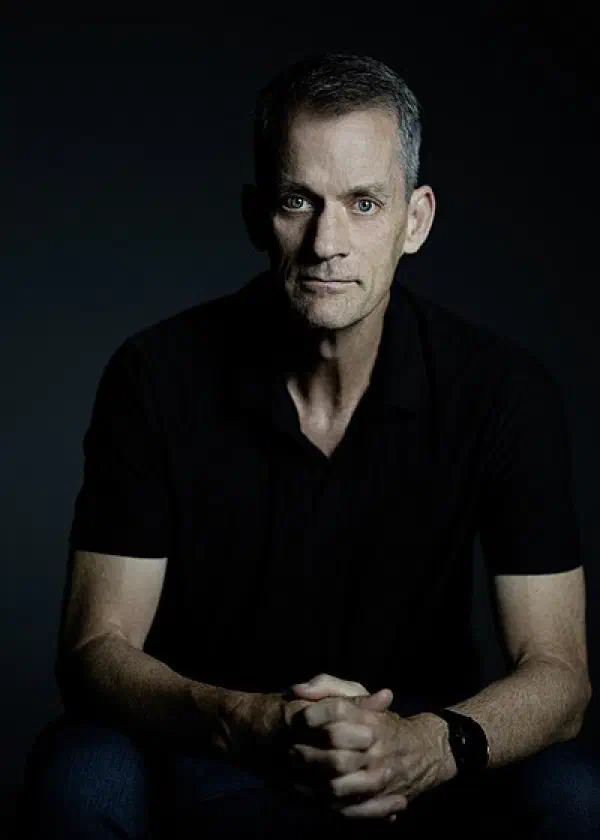
Chief Scientist at Google DeepMind and Google Research
Jeff Dean
Biographies
Profile
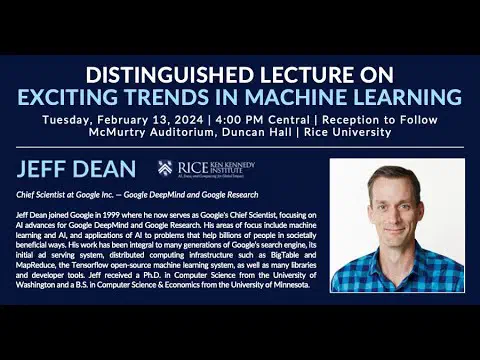
If you want to understand why modern AI works at all, you eventually have to understand Jeff Dean. He joined Google in mid-1999 as roughly its 20th employee, and for the next fifteen years he and Sanjay Ghemawat wrote the systems that let a company run computation across tens of thousands of unreliable commodity machines as if it were one computer: MapReduce, Bigtable, Spanner, Protocol Buffers, the crawling and indexing and serving stack behind Search. MapReduce alone spawned Hadoop and, indirectly, the entire big-data industry. None of that was AI work. All of it turned out to be the prerequisite.
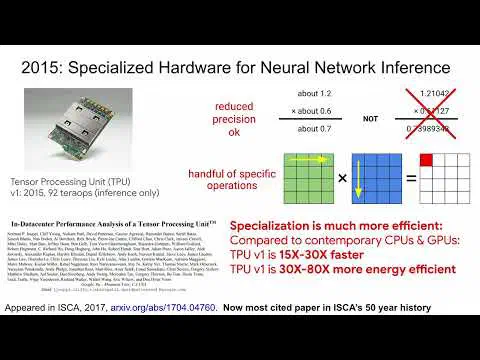
The pivot happened in 2011, when Dean co-founded Google Brain with Andrew Ng and Greg Corrado — famously starting as a 20%-time project. The team built DistBelief, trained a neural net on 16,000 CPU cores that learned to recognize cats from unlabeled YouTube frames, and demonstrated that the bottleneck in deep learning was engineering, not ideas. That insight defined the next decade of Dean’s career: DistBelief became TensorFlow, open-sourced in 2015 and the framework an entire generation of developers learned on; the realization that GPUs would be too expensive for Google-scale inference led to the TPU, now seven-plus generations deep and arguably Google’s single largest structural advantage over its competitors. Along the way he co-authored word2vec, knowledge distillation with Geoffrey Hinton and Oriol Vinyals, and the sparsely-gated mixture-of-experts paper with Noam Shazeer that the frontier labs are still mining today.
One correction worth making, because it circulates: Dean was not an author on Attention Is All You Need — that was Ashish Vaswani, Shazeer, and six colleagues at Google Brain. Dean’s contribution was upstream and arguably larger. He built the organization that hired those people, the hardware they trained on, and the framework they wrote it in. That’s the pattern of his whole career, and it’s the reason he’s more interesting to a working developer than most of the people with more Twitter followers: he is a systems person who understood before almost anyone that machine learning is a systems problem, and he has spent thirty years making the substrate cheaper.
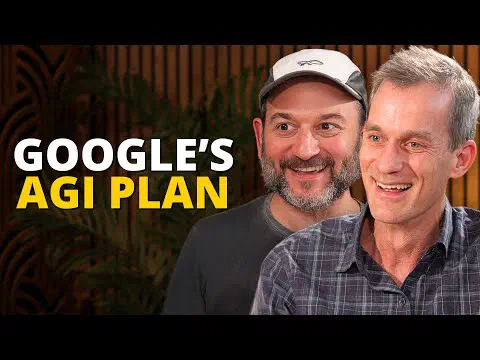
Since the April 2023 merger of Brain and DeepMind, Dean has been Chief Scientist across Google DeepMind and Google Research, reporting to Sundar Pichai alongside Demis Hassabis, and serving as a co-technical lead on Gemini. His public argument these days is about the Pareto frontier rather than raw capability: that distillation lets each generation’s Flash-tier model match or beat the previous generation’s Pro, that the real currency of inference is picojoules per bit rather than FLOPs, and that hardware has to be co-designed against a guess about what ML workloads will look like two to six years out. He also predicted in 2025 that AI systems would operate at the level of a junior engineer within a year — a claim worth holding him to. For anyone building with AI today, Dean’s talks are the highest-signal available explanation of why the cost curves move the way they do.
Key Articles & Papers
MapReduce: Simplified Data Processing on Large Clusters Large Scale Distributed Deep Networks (DistBelief) The Tail at Scale Efficient Estimation of Word Representations in Vector Space (word2vec) Distilling the Knowledge in a Neural Network TensorFlow: Large-Scale Machine Learning on Heterogeneous Distributed Systems Outrageously Large Neural Networks: The Sparsely-Gated Mixture-of-Experts Layer In-Datacenter Performance Analysis of a Tensor Processing Unit Pathways: Asynchronous Distributed Dataflow for ML Gemini: A Family of Highly Capable Multimodal ModelsVideos
Controversies
The Timnit Gebru dismissal (2020). As Google’s head of AI, Dean was the executive at the center of the exit of Timnit Gebru, co-lead of the Ethical AI team, after a dispute over the “Stochastic Parrots” paper and an internal email she sent criticizing Google’s diversity efforts. Dean sent a company-wide note characterizing the paper as failing internal review and her departure as a resignation; Gebru said she was fired. Margaret Mitchell, her co-lead, was terminated soon after. Dean later apologized for the handling — “we could have and should have handled the situation with more sensitivity” — though not to Gebru directly. It remains the defining test case for whether industry labs can host adversarial research about their own products, and it cost Google real credibility with the research community. Platformer’s account is the standard reference.
The AlphaChip reproducibility dispute (2021–present). Dean is a co-author on the Nature paper claiming reinforcement learning could produce chip floorplans matching or beating human engineers. Independent replication attempts — most prominently Andrew Kahng’s The False Dawn — failed to reproduce the advantage on public benchmarks, and a Google researcher who raised internal objections was dismissed. Nature attached an editor’s note and investigated. Dean, Anna Goldie, and Azalia Mirhoseini responded with That Chip Has Sailed, arguing the critiques ran the method without pre-training and at a fraction of the compute, and pointing to production TPU use. The core comparison is still hard to settle publicly because the original evaluation data is proprietary — which is itself the substance of the complaint.
The “Jeff Dean facts” meme. Not a controversy so much as a phenomenon: an internal Google joke genre (“Compilers don’t warn Jeff Dean. Jeff Dean warns compilers”) that escaped into the wider industry. Worth knowing because it says something real about engineering hero culture — and because the actual record underneath it is, unusually, strong enough to survive the mythology.
Spotify Podcasts





YouTube