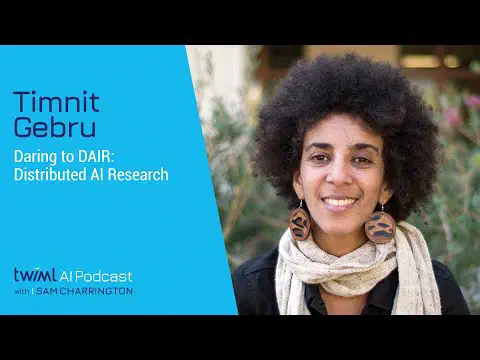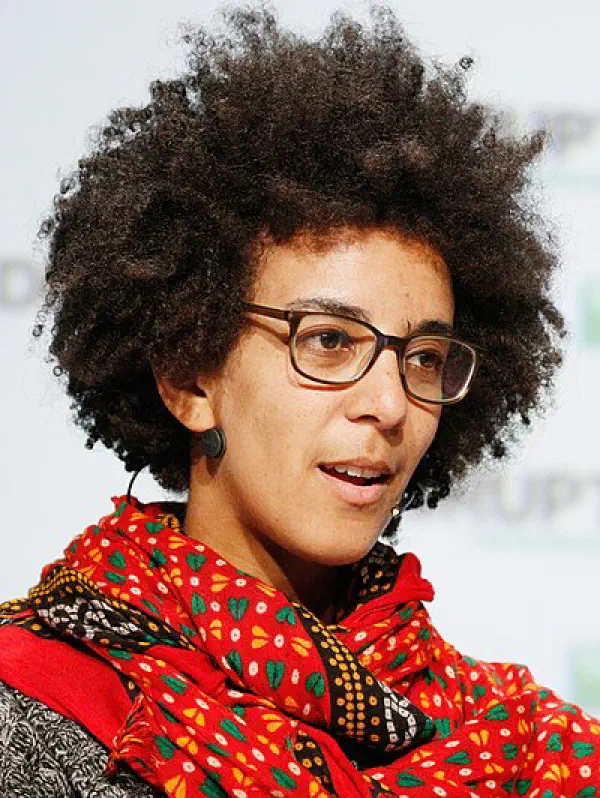
DAIR founder and Executive Director, AI ethics researcher
Timnit Gebru
Profile
Timnit Gebru is one of the few people who forced the AI industry to take its own ethics seriously — and she paid for it with her job. An Eritrean-Ethiopian-American computer scientist who fled Ethiopia as a teenager, she earned her PhD in computer vision at Stanford under Fei-Fei Li, after nearly a decade as a hardware engineer at Apple where she wrote signal-processing code for the first iPad. That combination — she has actually shipped production systems, not just critiqued them — is why developers should read her work rather than dismiss it as activism.
Her research is foundational to a truth the field now takes for granted: models inherit the biases of their data. With Joy Buolamwini she co-authored Gender Shades in 2018, which showed commercial facial-recognition systems misclassified darker-skinned women at rates near 35% while getting light-skinned men wrong less than 1% of the time. With Kate Crawford and others she wrote “Datasheets for Datasets,” proposing that every training set ship with documentation the way electronic components do — an idea that quietly became standard practice on teams that care about provenance. If you have ever written a model card or worried about what is actually in your corpus, you are downstream of her.
Then came the rupture. In late 2020, while co-leading Google’s Ethical AI team, Gebru co-wrote “On the Dangers of Stochastic Parrots,” warning that ever-larger language models carry environmental costs, encode bias at scale, and produce fluent text without understanding. Google demanded she retract it or strip her name; she pushed back, and the company terminated her — an event that drew a protest letter from thousands of employees and academics. Her co-lead Margaret Mitchell was fired weeks later. Read the paper now, after GPT-scale deployment, and much of it reads less like alarmism than a forecast.
Today she runs the Distributed AI Research Institute (DAIR), which she founded in December 2021 as a deliberately independent, community-rooted alternative to corporate labs, with researchers spread across Africa, Europe, Australia, and North America. She is a co-founder of Black in AI, a 2022 Time 100 honoree, and the 2025 Miles Conrad Award recipient. Her more recent work — including the “TESCREAL” critique of AGI-utopian ideologies — is more polarizing, but her core message to builders is consistent and worth hearing: the systems you ship reflect choices about whose interests they serve, and those choices are yours to make.
Key Articles & Papers
Gender Shades: Intersectional Accuracy Disparities in Commercial Gender Classification Datasheets for Datasets On the Dangers of Stochastic Parrots: Can Language Models Be Too Big? Using deep learning and Google Street View to estimate the demographic makeup of neighborhoods across the US The TESCREAL bundle: Eugenics and the promise of utopia through artificial general intelligenceVideos


Controversies
The Google firing (December 2020). Gebru’s exit from Google over the “Stochastic Parrots” paper is the defining controversy of her career and a watershed for AI ethics. Google characterized it as a resignation; Gebru says she was fired after refusing to retract the paper or remove her name without an accounting of who objected and why. The dispute exposed the tension between corporate research labs and independent inquiry, prompted Google to revise its publication-review and separation processes, and made her a lightning rod — celebrated as a whistleblower by some, criticized as combative by others.
TESCREAL and the AGI debate. Her more recent framing of transhumanist and effective-altruist thinking as a dangerous “bundle” of ideologies has drawn sharp pushback from those it names. Supporters see a sharp critique of Silicon Valley’s utopianism; critics call it an overbroad guilt-by-association argument. Developers should read the primary source and judge for themselves rather than rely on secondhand summaries from either side.
Spotify Podcasts








YouTube