

NVIDIA Director of AI, Project GR00T and embodied agent research
Jim Fan
Profile
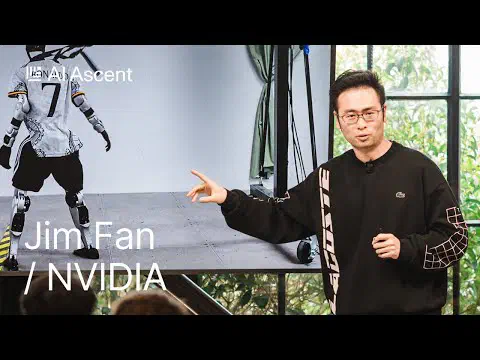
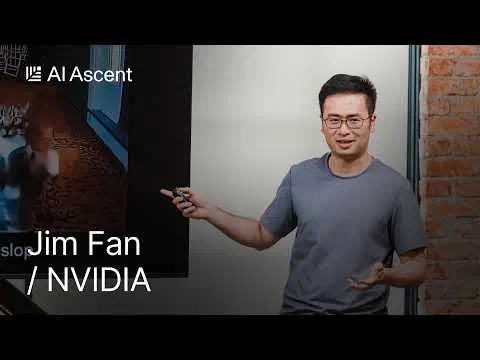
Linxi “Jim” Fan is NVIDIA’s Director of AI and a Distinguished Research Scientist, co-founder of the GEAR lab (Generalist Embodied Agent Research) alongside Yuke Zhu, and co-lead of Project GR00T — the company’s moonshot to build a foundation model for humanoid robots. His CV reads like a tour of every place AI happened: Columbia valedictorian, Stanford PhD under Fei-Fei Li, stints at Baidu AI Labs and MILA, and — the line he’s most known for — OpenAI’s very first intern, where he worked on World of Bits with Andrej Karpathy back when “web agents” sounded absurd. That last detail matters more than trivia: Fan has been chasing the same idea for a decade, which is agents that act in open-ended environments rather than models that answer questions.
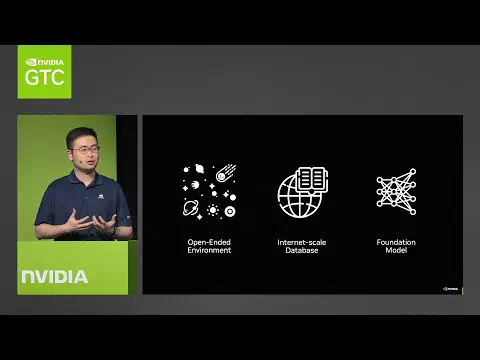
The through-line from that decade is worth understanding if you’re building agents today. MineDojo (2022) argued that you could ground an agent in internet-scale knowledge — YouTube videos, wiki pages, forum posts — instead of a hand-crafted reward. Voyager (2023) took the next step and is still the cleanest demo of the pattern most agent frameworks converged on: GPT-4 writing JavaScript, running it, reading the error, rewriting it, and committing the working version to a persistent skill library it can retrieve later. No gradient updates, no fine-tuning — lifelong learning as code plus memory. Then Eureka closed the loop the other way: an LLM writing reward functions, evaluated at massive parallelism in GPU simulation, beating human-expert rewards on 83% of 29 environments. If you’ve ever wondered what the actual research lineage of “agentic loop with tools and memory” is, it runs through these papers.
Since 2024 that agenda has moved from Minecraft to motors. GR00T N1, released open-weight at GTC 2025, is a 2B-parameter vision-language-action model with a deliberately dual-system design — a VLM that reasons slowly about the scene and instruction, and a diffusion transformer that emits joint actions at real-time frequency. The bottleneck it exists to solve is data: there is no internet of robot trajectories, so GEAR manufactures one. DreamGen fine-tunes video world models to hallucinate photorealistic robot footage, then recovers pseudo-actions with an inverse-dynamics model — “neural trajectories.” A robot trained on a single pick-and-place demo picked up 22 new behaviors this way. The subsequent GR00T N1.5 was reportedly built in 36 hours on synthetic data that would have taken months to teleoperate. Whether or not you buy the humanoid thesis, that’s the most interesting bet in robotics right now: that generative video is the pretraining corpus physical AI never had.
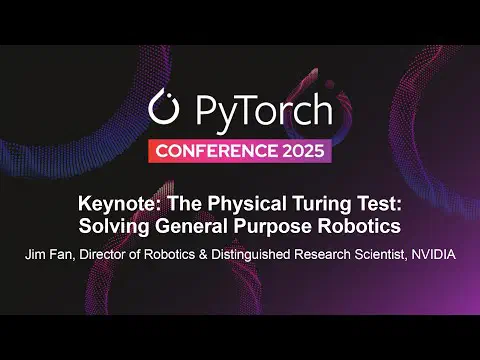
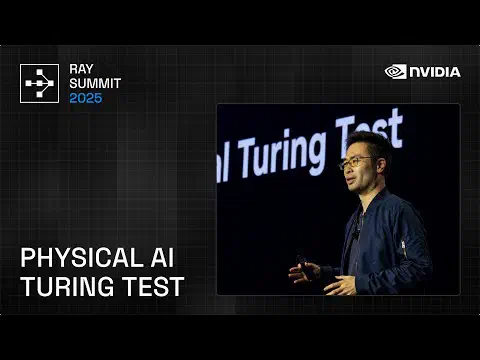
Fan is also, functionally, robotics’ most effective explainer — his “Physical Turing Test” framing (come home to a spotless apartment and a candlelit dinner, and you can’t tell who did it) has become the field’s shorthand goal. In 2026 he’s sharpened into something more contrarian: language-first VLA models are “head-heavy” and fumble the verbs of physics; teleoperation is a dead end and now makes up under 0.1% of NVIDIA’s training mix; the future is video-first world-action models predicting future pixels and joint torques together. He predicts a passed Physical Turing Test in 2–3 years and a completed robotics “technology tree” by 2040. Read him with the discount you’d apply to anyone whose employer sells the compute — but read him. Unlike most people making these claims, he ships open weights, open datasets, and open code.
Key Articles & Papers
Voyager: An Open-Ended Embodied Agent with Large Language Models MineDojo: Building Open-Ended Embodied Agents with Internet-Scale Knowledge Eureka: Human-Level Reward Design via Coding Large Language Models GR00T N1: An Open Foundation Model for Generalist Humanoid Robots DreamGen: Unlocking Generalization in Robot Learning through Neural Trajectories VIMA: General Robot Manipulation with Multimodal Prompts The Physical Turing Test: Jim Fan on NVIDIA's Roadmap for Embodied AI GR00T N1.5: An Improved Open Foundation Model for Generalist Humanoid Robots NVIDIA Isaac GR00T (open-source repo) A Mine-Blowing Breakthrough: AI Agent Voyager Autonomously Plays MinecraftVideos

Controversies
There is no personal scandal here, but there is a real and ongoing argument about credibility in humanoid robotics, and Fan sits on both sides of it.
The messenger problem. Fan is the most quoted voice predicting near-term physical AGI while working for the company that sells the training hardware, the simulator, and now the robot foundation models. Timelines like “Physical Turing Test in 2–3 years” and “technology tree complete by 2040” are unfalsifiable in the short run and commercially useful in the short run — a combination worth noting. Skeptics point out that GR00T demos are shown on partner hardware in curated settings, and that impressive lab manipulation has historically not survived contact with unstructured homes.
Demo integrity — where he’s the critic. To his credit, Fan has been among the loudest people calling out the field’s evaluation hygiene. He has argued that many viral robot videos are the single best take out of hundreds, that the field has no shared reproducible benchmark, and that “in 2026 we must do better and stop treating reproducibility and scientific discipline as second-class citizens.” He has separately vouched publicly for specific third-party demos being real rather than CGI — useful, but also a reminder that the field currently relies on personal say-so instead of standardized evaluation.
Verdict for developers: treat his timelines as advocacy and his artifacts as evidence. The papers, weights, and datasets are open and reproducible; the predictions attached to them are not yet.
Spotify Podcasts







YouTube