

VP of AI & Open Source at Voltron Data, AI Engineering author
Chip Huyen
Profile
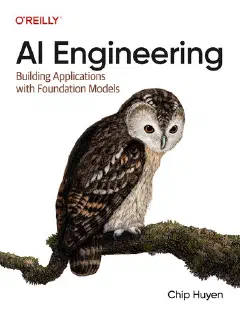
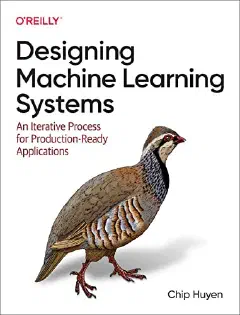
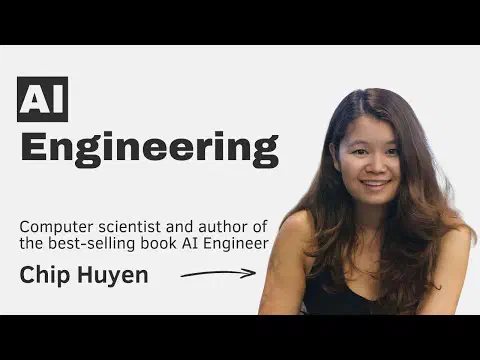
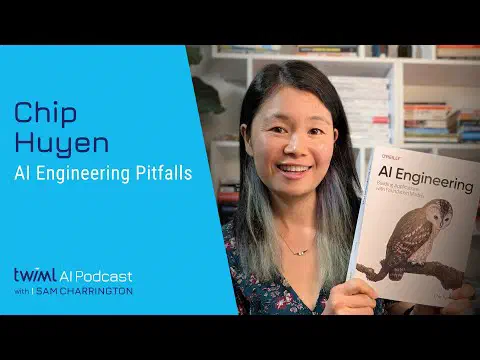
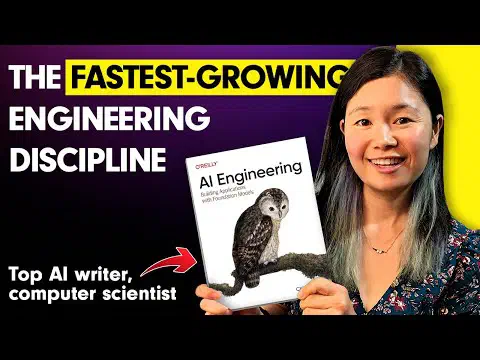
Chip Huyen is the person most developers end up reading when they stop asking “how do I train a model?” and start asking “how do I ship one?” She is the author of two of the most widely read practical AI books in the industry — Designing Machine Learning Systems (2022) and AI Engineering (2025) — and the second of those was the most-read book on O’Reilly’s platform in the year it launched. That is not a marketing statistic so much as a diagnosis of where the field is: thousands of engineers with solid software backgrounds needed a map of the foundation-model stack that wasn’t a vendor pitch, and she wrote it.
Her career reads like a deliberate tour of every layer where AI actually breaks. She was a core developer on NVIDIA’s NeMo, did ML research at Netflix, worked on data-centric tooling at Snorkel AI, and taught CS 329S: Machine Learning Systems Design at Stanford — the course that became Designing Machine Learning Systems. In 2022 she co-founded Claypot AI, a real-time feature engineering platform, which was acquired by Voltron Data in January 2024. There she served as VP of AI & Open Source Software, working on GPU-accelerated distributed data processing. As of 2026 she has moved on again and is building a new stealth startup.
What makes her worth reading, as opposed to merely worth following, is her refusal to let abstraction outrun evidence. The blog post “What I learned from looking at 900 most popular open source AI tools” is exactly what it says — she scraped the ecosystem and reported what was actually there, including the unflattering parts about how many projects are thin wrappers. “Building A Generative AI Platform” is a reference architecture that engineers have quietly copied into design docs at hundreds of companies. Her 8,000-word essay on agents arrived while the term was still mostly vibes and gave it a usable definition. She writes about evaluation — the genuinely hard, genuinely unglamorous problem — more than anyone at her level of visibility, and AI Engineering devotes serious space to it while most content on the topic skips straight to RAG diagrams.
For a developer learning AI today, the practical value is this: she draws the line between what you should build and what you should buy, and she keeps redrawing it as models get better. Her framing — start with prompting, escalate to RAG, escalate to finetuning only when you’ve proven you need it — has become close to default industry practice, largely because she articulated it clearly before it was obvious. Alongside authors like Aurélien Géron and Sebastian Raschka, she occupies the narrow and valuable space of people who write technical books that survive contact with production. Where they teach you the models, she teaches you the system around them.
Books
Key Articles & Papers
Agents Common pitfalls when building generative AI applications Building A Generative AI Platform What I learned from looking at 900 most popular open source AI tools Generation configurations: temperature, top-k, top-p, and test time compute Multimodality and Large Multimodal Models (LMMs) Open challenges in LLM research RLHF: Reinforcement Learning from Human Feedback Building LLM applications for production Real-time machine learning: challenges and solutionsVideos


Spotify Podcasts
![[Recension] Designing Machine Learning Systems (Chip Huyen) Sammanfattad.](/images/people/chip-huyen/spotify/7jMYfePCwhcyZutRYyPBl9_hu_e9f181befc883ba2.webp)



YouTube