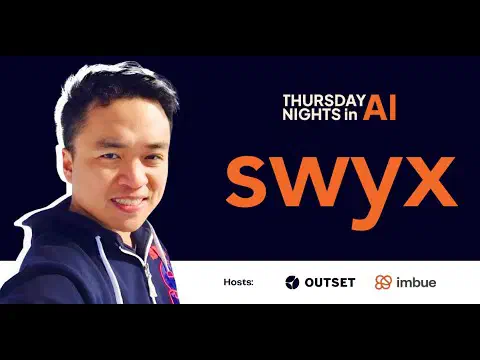

Latent Space editor, AI Engineer founder
Swyx
Profile
Shawn Wang — universally known as swyx — is the person who gave a name to what most developers reading this are actually doing. In June 2023 he published “The Rise of the AI Engineer”, arguing that the gap between ML researchers who train foundation models and product engineers who ship features had collapsed into a new discipline: people who wield models through APIs, evals, and orchestration rather than gradient descent. The essay landed hard, Andrej Karpathy endorsed the framing, and “AI Engineer” went from a coinage to one of the fastest-growing job titles in tech. Whether you think that was prescience or branding, it worked.
His path there was unusual. Wang grew up in Singapore and spent his first career in finance — currency options trading, hedge fund analysis, quantitative portfolio work — before switching into software in his late twenties. That second act was almost entirely developer relations and developer experience: moderating r/reactjs, cofounding Svelte Society, then DX roles at AWS, Netlify, Temporal, and Airbyte. Along the way he wrote “Learn In Public”, an essay that has probably shaped more junior developers’ careers than anything else he’s written, and turned that thinking into The Coding Career Handbook. The through-line is consistent: he is a community-builder and a taxonomist, someone who names things so other people can organize around them.
Today he runs three connected things. Latent Space is the newsletter and podcast he edits — past 200,000 subscribers and 10 million viewers across channels, consistently a top-10 US tech podcast, and genuinely technical in a way most AI media isn’t. He is cofounder and CEO of AI Engineer, whose World’s Fair drew 6,000+ engineers, 300 speakers, and 29 tracks to Moscone Center in mid-2026, plus regional editions. And he founded Smol AI, whose AI News daily digest is assembled almost entirely by research agents scraping Discords, subreddits, and X — a working demonstration of his own thesis rather than a description of it. He also contributes to coding-agent evaluation standards at Cognition.
For a developer learning AI, swyx’s real value is as a map-maker. He does not train models and does not pretend to. What he does is compress a chaotic field into legible structure — the AI Engineering Reading List, the shift from prompt engineering to agent engineering to “Loopcraft” (his 2026 argument that the highest-leverage skill is designing the system that writes your prompts, not writing the prompt). His frameworks are sometimes over-tidy and his conference keynotes lean on acronyms that don’t always survive contact with production. But the Latent Space back catalogue is one of the best free educations available in how people actually build with LLMs, and the interviews get builders talking in engineering terms rather than marketing ones.
Books
Key Articles & Papers
The Rise of the AI Engineer Learn In Public The 2025 AI Engineering Reading List Agent Engineering Loopcraft: The Art of Stacking Loops 5 Trends That Defined AI Engineering at World's Fair 2026 Scaling without Slop Software 3.0 and the AI Engineer Landscape AIEWF Daily Dispatch: Loops, Software Factories & Forward Deployed EngineersVideos

Controversies
Is “AI Engineer” a real discipline or a rebrand? The main criticism of swyx is that his signature contribution is a label, not a technology. Skeptics argue the title has been diluted to the point of meaninglessness — that calling an OpenAI API from a web app and putting “AI Engineer” on LinkedIn is closer to the 2014 “Growth Hacker” moment than to a genuine new engineering specialty, and that the term dresses up ordinary backend work. RedMonk’s coverage treats the definition as genuinely contested rather than settled, and critiques questioning whether the role exists at all have circulated since 2025.
In fairness, swyx has not been a triumphalist about it. He has publicly acknowledged the hype cycle and said explicitly that an AI winter will eventually return. And the counter-evidence is hard to dismiss: 6,000 engineers paying to attend a conference about a job category that didn’t exist three years earlier suggests he identified something real, even if the label attracted more people than it can meaningfully describe. The fair reading is that he is a genuine and early pattern-recognizer who also happens to have a strong commercial interest in the pattern he named.
Spotify Podcasts






![Code Interpreter is GPT-4.5: A Summer AI Technical Roundup [feat. Swyx and Alessio of Latent Space]](/images/people/swyx/spotify/12ZOsHypWCTE9pjPJb34GG_hu_ce1c19c5a6de6aac.webp)
YouTube