
Distinguished Scientist at Google DeepMind, AlphaFold lead
John Jumper
Profile
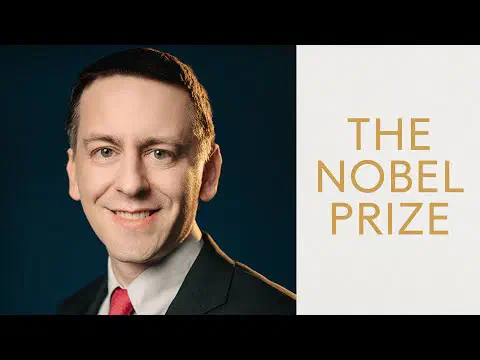
John Jumper is the clearest existence proof we have that machine learning can do real science — not “assist with” science, not “accelerate workflows,” but solve a problem that a field had been stuck on for fifty years. He led the team at Google DeepMind that built AlphaFold, the system that predicts a protein’s three-dimensional structure from its amino acid sequence, and in 2024 he shared the Nobel Prize in Chemistry with Demis Hassabis and David Baker of the University of Washington. He was 39 — the youngest chemistry laureate in over seventy years.
His path there is worth knowing, because it does not look like an AI career. Jumper studied physics and math at Vanderbilt, went to Cambridge on a Marshall Scholarship intending to become a pen-and-paper theoretical physicist, decided it wasn’t for him, and left with a master’s. He spent three years at D. E. Shaw Research doing molecular dynamics simulations, then went back for a PhD in theoretical chemistry at the University of Chicago, where he started applying machine learning to protein folding physics. He joined DeepMind in 2017 and was handed the AlphaFold team about six months after finishing that PhD. The lesson for anyone learning AI: the differentiating skill was not deep learning expertise, which was widely available. It was that he understood proteins deeply enough to know which inductive biases the architecture needed. AlphaFold 2’s Evoformer and structure module are full of domain-specific design — triangle attention respecting distance-geometry constraints, an SE(3)-equivariant output head, recycling — that nobody would have invented from a generic sequence-modeling mindset.
The results speak plainly. AlphaFold 2 arrived at CASP14 in 2020 with accuracy competitive with experimental structures, ending a benchmark competition that had run since 1994. DeepMind then predicted structures for essentially every protein known to science — over 200 million — and released them free through the AlphaFold Protein Structure Database with EMBL-EBI. Millions of researchers in nearly every country have used it. AlphaFold 3 (2024) replaced the structure module with a diffusion-based architecture and generalized to protein–ligand, protein–DNA, and protein–RNA complexes — the interactions that actually matter for drug design, which is why DeepMind’s spinout Isomorphic Labs exists.
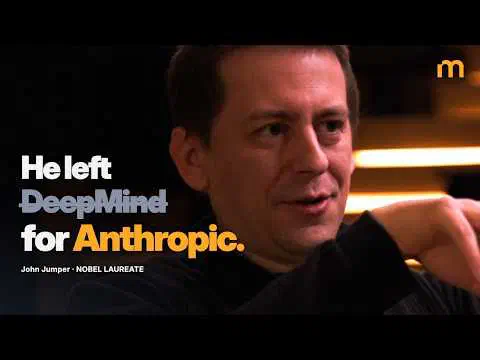
Where he is now is the interesting part. In June 2026, after nearly nine years, Jumper announced he was leaving Google DeepMind for Anthropic, taking time to recharge first, and bringing core AlphaFold collaborators Jonas Adler and Alexander Pritzel with him. Neither he nor Anthropic has said publicly what he’ll build; the honest framing is “AI for science,” against a backdrop of Anthropic’s 2026 push into life sciences. It landed alongside reporting that DeepMind had dispersed the original AlphaFold team as its strategy shifted from targeted grand challenges toward Gemini-powered general “AI scientist” systems. That tension — narrow, domain-shaped models that actually solve a problem versus general models pointed at everything — is the live argument in AI-for-science right now, and Jumper is the person whose next project will be read as a vote.
Key Articles & Papers
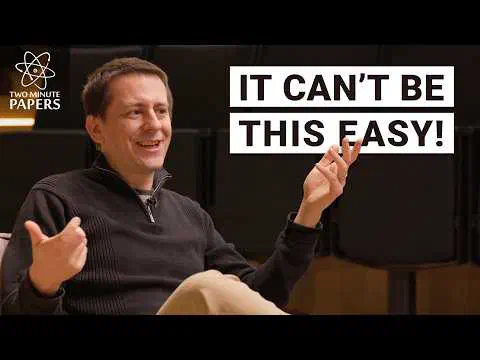
Highly accurate protein structure prediction with AlphaFold Accurate structure prediction of biomolecular interactions with AlphaFold 3 Highly accurate protein structure prediction for the human proteome Protein complex prediction with AlphaFold-Multimer Nobel Lecture: Building chemical and biological intuition into protein structure prediction Chemistry Nobel goes to developers of AlphaFold AI that predicts protein structures Demis Hassabis & John Jumper awarded Nobel Prize in Chemistry What's next for AlphaFold: A conversation with a Google DeepMind Nobel laureate AlphaFold3 — why did Nature publish it without its code? Addendum: Accurate structure prediction of biomolecular interactions with AlphaFold 3Videos

Controversies
AlphaFold 3 published without code. When AlphaFold 3 appeared in Nature in May 2024, the paper shipped with pseudocode and a rate-limited web server rather than runnable software — and the server initially blocked exactly the protein–ligand predictions that drug researchers wanted most. Over a thousand scientists signed an open letter arguing this broke basic reproducibility norms and Nature’s own code-availability policy. Nature defended the decision on commercial-sensitivity grounds. DeepMind released the code for non-commercial use in November 2024, six months later. It’s a fair criticism, and a useful case study: the same organization that gave away 200 million structures for free also withheld the model that superseded them, because Isomorphic Labs had a commercial stake. Both facts are true.
The AlphaFold team’s dissolution. Reporting in 2026 described DeepMind reassigning most of the original AlphaFold paper’s authors and losing close to a quarter of them, with Jumper, Jonas Adler, and Alexander Pritzel all landing at Anthropic. DeepMind confirmed the moves, said it remains proud of AlphaFold, and framed the shift as a deliberate strategic move from focused grand challenges toward general Gemini-based “AI scientist” systems. Reasonable people read it two ways — a natural reorganization after a project reached its goal, or a Nobel-winning team allowed to disperse — and the evidence supports arguing either.
Spotify Podcasts




![[6/22 00:00] John Jumper leaves Google DeepMind for Anthropic / Linux Foundation forms Appia Foundation for AI conformity standards](/images/people/john-jumper/spotify/64mWOj0lMYAIZeGmDQOS9x_hu_2df88014c89504bd.webp)


YouTube