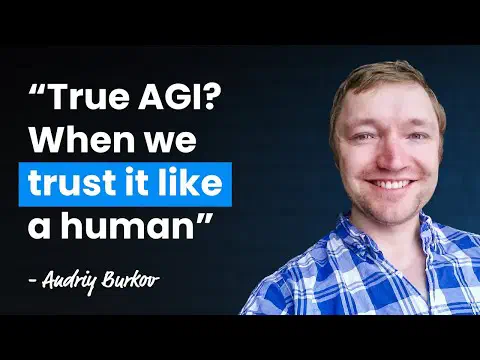

Machine learning leader at TalentNeuron, author of two Hundred-Page books
Andrei Burkov
Profile
Andriy Burkov occupies an unusual niche in the AI world: he’s the guy who proved that you don’t need 800 pages to teach a subject that everyone else treats as impossibly vast. His Hundred-Page Machine Learning Book, self-published in 2019, became one of the most quietly influential technical books of the era — translated into more than a dozen languages, adopted as a university textbook worldwide, and permanently parked on the shelf of nearly every working data scientist. In an industry drowning in hype and 12-hour video courses, Burkov’s bet was the opposite of everything: rigor, compression, and respect for the reader’s time. It paid off.
He is not primarily an academic or a startup founder — he’s a practitioner. Burkov holds a PhD in AI from Université Laval in Quebec (his dissertation was on multi-agent decision-making), and he spent the bulk of his career shipping production ML, not writing papers about it. He led data science and machine learning teams at Gartner for over seven years and did earlier stints touching applied AI at Fujitsu. Today he is Head of Machine Learning at TalentNeuron, where his team parses billions of job postings across 30+ languages in near-real-time to turn messy labor-market data into structured intelligence. That “real terabytes, real deadlines” background is exactly why developers trust him: he writes like someone who has been paged at 3am because a model broke.
His follow-ups extended the franchise. Machine Learning Engineering (2020) tackled the unglamorous-but-critical MLOps layer — data collection, testing, deployment, monitoring — that most ML books skip entirely. Then in January 2025 came The Hundred-Page Language Models Book, which walks readers from count-based n-grams through RNNs to coding a Transformer from scratch in PyTorch, all runnable on Google Colab. It’s arguably his most impressive compression feat yet: modern LLMs, demystified, without the mysticism. For a developer or student who wants to actually understand what’s under the hood — not just call an API — it belongs in the same tier as the work of Sebastian Raschka and Aurélien Géron.
What makes Burkov worth following beyond the books is his voice. With roughly 900K LinkedIn followers, he’s become one of the most prominent skeptics of AI hype — not a doomer, not a denier, but a working engineer who insists on separating what LLMs and agents can actually do from what the marketing decks claim. He argues loudly that agents are being oversold, that LLMs have no built-in mechanism to know when they don’t know, and he even built a deliberately LLM-free chatbot to prove a point about hallucination. For a young person learning AI in 2026, Burkov is a useful antidote: he teaches the fundamentals with real depth, then tells you, unsentimentally, where the current tools break.
Books
Key Articles & Papers
It's here: My new book on Language Models Andriy Burkov's Journey to Writing the Ultimate 100-Page Machine Learning Book The Hundred-Page Language Models Book: A Great Technical Intro to LLMsVideos


Controversies
Burkov has no scandal to speak of — his “controversy” is intellectual, and deliberate. He is one of the most vocal skeptics of the current LLM-and-agents boom, publicly arguing (notably on the SuperDataScience podcast episode “LLMs and Agents Are Overhyped”) that autonomous agents are being oversold and that LLMs fundamentally cannot recognize the limits of their own knowledge. Critics counter that he underrates how fast the frontier is moving; supporters see him as a necessary, evidence-first corrective to breathless marketing. Either way, his stance is a considered engineering position, not a stunt — and worth weighing rather than dismissing.
A note on the name: the database lists him as “Andrei Burkov,” but he publishes and is known everywhere as Andriy Burkov — you may want to correct the profile title/slug accordingly.
Spotify Podcasts


YouTube