

Cohere CEO, Transformer co-author, enterprise AI leader
Aidan Gomez
Profile
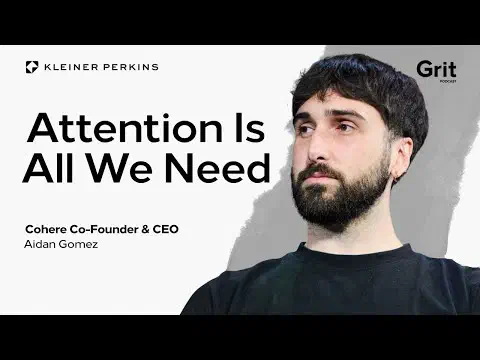
Aidan Gomez has one of the strangest résumés in AI: he was a 20-year-old University of Toronto undergrad interning at Google Brain when he became the youngest of eight authors on Attention Is All You Need — the 2017 paper that introduced the Transformer and, in retrospect, the architecture every model you use today is built on. He worked alongside Ashish Vaswani and Noam Shazeer, finished a PhD at Oxford in 2024 while already running a company, and did research under Geoffrey Hinton along the way. For a developer, the useful thing about Gomez isn’t the origin story — it’s that his pre-Cohere papers are genuinely worth reading. The Reversible Residual Network and Targeted Dropout are both about squeezing more out of constrained hardware, which turned out to be the through-line of his entire career.
In 2019 he left Google to co-found Cohere with Ivan Zhang and Nick Frosst, and made a bet that looked wrong for about four years: skip the consumer chatbot entirely, sell to enterprises, and stay deployment-agnostic — VPC, on-prem, air-gapped, whatever the bank’s compliance team demands. While OpenAI and Anthropic fought over consumers and developers, Cohere built Command, Embed, and Rerank for RAG pipelines, then North as an agent workspace for regulated industries. It worked. Cohere closed 2025 at roughly $240M ARR with gross margins near 70%, raised $600M at a $7B valuation from Nvidia, Salesforce, and AMD, and hired a CFO who took Uber public. Meanwhile Cohere Labs — the open research arm, formerly Cohere For AI, run for years by Sara Hooker before she left in 2025 to start Adaption Labs — shipped the Aya multilingual models, which are still among the best open options if you’re working outside English.
The second bet is sovereign AI, and it’s the reason Gomez matters right now. In April 2026 Cohere announced a merger with Germany’s Aleph Alpha, backed by the Canadian and German governments, valuing the combined company around $20B with Schwarz Group leading a €500M Series E. The pitch to G7 governments is blunt: run frontier AI on your own soil under your own law, or rent your future from three American hyperscalers. A month later Cohere shipped Command A+ — a 218B-parameter sparse MoE with 25B active, 128K context, 48 languages, native citation grounding, and W4A4 quantization that fits on two H100s — under a true Apache 2.0 license. That combination is the whole thesis in one artifact: frontier-ish quality, actually deployable on-prem, no license lawyer required.
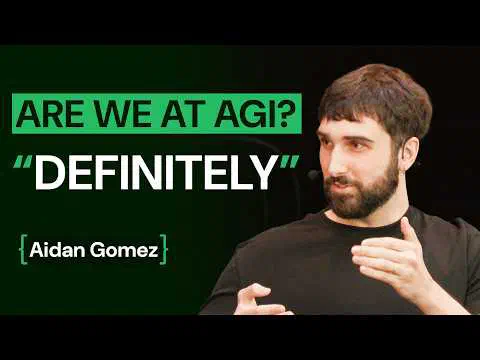
Gomez is also the loudest counterweight to the doom conversation among frontier lab CEOs. He has called debating superintelligent AGI takeover “an absurd use of our time,” arguing the real risks are mundane and present — misinformation, misuse, bad deployments — not extinction. Whether you agree or not, his position is coherent with what he builds: models sized for banks and telcos, not for a race to a singularity. For someone learning AI today, Cohere is the clearest available proof that the enterprise and non-US markets are real, large, and buildable — and that “smaller model, better retrieval, deployed where the data lives” is still a winning architecture.
Key Articles & Papers
Attention Is All You Need One Model To Learn Them All The Reversible Residual Network: Backpropagation Without Storing Activations Targeted Dropout Command A: An Enterprise-Ready Large Language Model Introducing Command A+ Aya: An Instruction Finetuned Open-Access Multilingual Language Model Aidan Gomez — PublicationsVideos






Controversies
Publisher copyright lawsuit (2025–present). In February 2025, a coalition including Condé Nast, The Atlantic, Forbes, The Guardian, Vox, the Los Angeles Times, Politico, and the Toronto Star sued Cohere in the Southern District of New York for “massive, systematic copyright infringement and trademark infringement,” citing 4,000+ works and 75 specific examples of verbatim or near-verbatim output. The complaint also alleges Cohere hallucinated fabricated articles and attributed them to the publishers’ brands. Cohere’s motion to dismiss was rejected in full, with the court finding the outputs “quantitatively and qualitatively similar” to the originals. Cohere denies wrongdoing and the case is ongoing — worth watching, because the ruling on AI news summaries has implications far beyond Cohere.
Dismissing existential risk. Gomez has repeatedly called AI extinction debate “an absurd use of our time and the public’s mind space”, putting him at odds with Geoffrey Hinton, Dario Amodei, and much of the safety community. Critics note the convenience of the position for someone selling models to regulated industries; defenders point out he consistently names concrete harms — misinformation, misuse — rather than dismissing risk entirely.
Valuation versus revenue. The $20B combined valuation for Cohere and Aleph Alpha sits on roughly $240M of ARR, and Aleph Alpha had exited the foundation-model business in 2024 with minimal revenue of its own. Skeptics argue the sovereign-AI framing, plus Canadian and German government backing, is doing a lot of the pricing work. Gomez’s counter is that regulated and public-sector AI is a market US labs structurally cannot serve — a claim that the next few years, and a likely IPO, will test in public.
Spotify Podcasts








![#80 AIDAN GOMEZ [CEO Cohere] - Language as Software](/images/people/aidan-gomez/spotify/2YTr7Mpqq8MI27SG98m1fe_hu_6e6f68052c8adbc0.webp)
YouTube