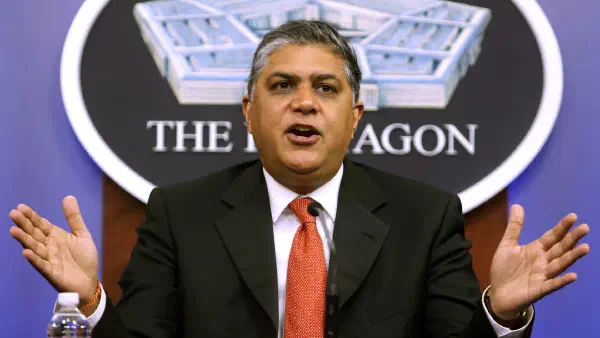
Hoover fellow and tech entrepreneur, former CIA CTO
Nand Mulchandani
Profile
Nand Mulchandani is what happens when a Silicon Valley serial entrepreneur spends six years trying to make the U.S. national security apparatus ship software like a startup. He is a rare bridge figure — someone who founded and sold four companies (Oblix to Oracle, Determina to VMware, OpenDNS to Cisco, and ScaleXtreme to Citrix) before becoming the CIA’s first-ever Chief Technology Officer. For developers trying to understand how AI actually gets deployed inside enormous, risk-averse institutions, his career is a case study in the unglamorous half of the job: not training the model, but wiring it into a bureaucracy that was never built to move fast.
His path runs through the pillars of the American establishment — Computer Science and Math at Cornell, a management master’s from Stanford, and a Harvard MPA — before a first job as a compiler architect at Sun Microsystems in 1991. But the pivot that matters came in 2019, when he left venture-backed startup life to become CTO (and later acting director) of the Pentagon’s Joint Artificial Intelligence Center, the DoD’s central AI shop. There he pushed the government to adopt a venture-capital-style, product-driven approach to AI — MVPs over multi-year procurement, agility over specifications frozen years in advance. In 2022 he moved to Langley as the CIA’s inaugural CTO, principal technology adviser first to Director William Burns and then across the transition into the Trump administration.
What makes Mulchandani genuinely useful to an AI-building audience is his temperament: he is a public skeptic of hype from inside the hype machine. He has repeatedly argued that AI is not magic — that the hard, valuable work is deployment, data plumbing, evaluation, and organizational change, not the demo. At the CIA he was candid that generative AI’s tendency to hallucinate makes it a tool to be handled carefully in an intelligence context where being confidently wrong can be catastrophic, and he championed the agency’s use of AI for triaging the firehose of open-source information rather than as an oracle. That combination — builder’s optimism, operator’s caution — is exactly the posture a developer moving from notebooks to production should study.
He stepped down from the CIA on June 21, 2025, precisely three years to the day after starting, and now occupies the independent-adviser tier of the AI-and-national-security world. He is a Visiting Fellow (2025–26) at the Hoover Institution at Stanford, working with its Technology Policy Accelerator on defense-tech innovation and “preventing strategic technical surprise,” continues as an adviser to the CIA, and in September 2025 joined the board of Second Front Systems, a defense-software company. His move out of government — and straight into the fellowship-plus-board-seat orbit — is itself a signal of how much AI policy expertise now lives in the space between the Valley, academia, and the Pentagon. Alongside figures like Palmer Luckey, Alex Karp, and Eric Schmidt, he is helping define what “American Dynamism” in defense tech actually means in practice.
Key Articles & Papers
The CIA's first CTO, Nand Mulchandani, prepares for the Trump administration Intelligence in the Age of AI with the new CTO of the CIA The CIA's CTO on AI, National Security, and Silicon Valley's Role in the Future of Tech The Pentagon's AI Shop Takes a Venture Capital Approach to Funding Tech Making War a Software Problem: JAIC Director on JADC2Videos
Spotify Podcasts






YouTube