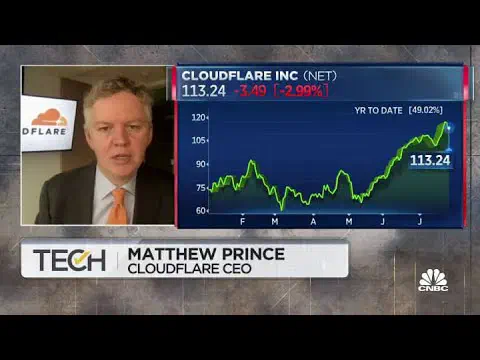

Cloudflare CEO, building fair economics for creators in the AI era
Matthew Prince
Profile
Matthew Prince is the co-founder and CEO of Cloudflare, the infrastructure company that sits in front of roughly a fifth of the web — reverse-proxying, caching, and defending millions of sites against attack. That position, quietly accumulated since 2010, has made him one of the most consequential non-model-building figures in the AI era. Prince didn’t train a frontier model or ship a chatbot. He controls a chokepoint, and in 2025 he decided to use it to renegotiate the economics of who pays for the content that AI systems are built on.
His path there was circuitous. Born in Salt Lake City and raised in Park City, Utah, Prince studied English literature and computer science at Trinity College, earned a J.D. from the University of Chicago Law School (where he studied under Richard Posner), and later got his MBA at Harvard Business School. Along the way he co-created Project Honey Pot, a distributed system for tracking how spammers harvested email addresses. At HBS he met Michelle Zatlyn; together with engineer Lee Holloway they turned the “we can see the threats, why not stop them?” insight into Cloudflare, which launched at TechCrunch Disrupt in 2010. For developers, the relevant lesson is that Cloudflare’s whole business is built on aggregating traffic — and aggregated traffic is leverage.
That leverage is why his current campaign matters. Prince’s argument is blunt and, for anyone building or publishing on the web, hard to ignore: the old bargain — Google crawls your content and sends you traffic in return — is collapsing as search becomes “answer engines.” When an AI gives the answer directly, no click, no referral, no ad revenue flows back to the creator. His much-quoted line: “The great patron of the internet for the last 27 years was Google. The great villain of the internet today is also Google.” In July 2025 Cloudflare declared Content Independence Day, becoming the first major infrastructure provider to block AI crawlers by default unless the site owner opts in — flipping the web’s implicit permission model from opt-out to opt-in. Alongside it came Pay Per Crawl, an experimental marketplace where publishers set a price and Cloudflare brokers the transaction between crawler and creator.
Whether this becomes the standard economic layer for AI training data or an interesting footnote is genuinely undecided — Prince himself sketches multiple futures, some of which don’t favor Cloudflare. But for developers learning AI, he’s worth understanding precisely because he’s fighting on the plumbing layer everyone else takes for granted. The models get the headlines; the questions of consent, compensation, and who is allowed to crawl what are being decided in robots.txt, WAF rules, and the terms Prince is trying to impose. He has also taken the fight to regulators, pressing the UK’s Competition and Markets Authority to force Google to separate its search crawler from its AI crawler — arguing Google gets for free what OpenAI, Anthropic, and Perplexity would have to pay for.
Key Articles & Papers
Content Independence Day: no AI crawl without compensation! Cloudflare Just Changed How AI Crawlers Scrape the Internet-at-Large An Interview with Cloudflare CEO Matthew Prince About Internet History and Pay-per-crawl Cloudflare CEO Matthew Prince: Google is abusing its monopoly in search to feed its AI The accidental guardian: How Cloudflare's Matthew Prince became publishing's unexpected defender Matthew Prince — TIME100 Most Influential People in AI 2025 Cloudflare CEO Matthew Prince is pushing UK regulator to unbundle Google's search and AI crawlers Cloudflare CEO wants to save the web from AI's oligarchs — here's why his plan isn't crazyControversies
Prince’s most-debated moments came before the AI-crawler fight, over content moderation and the power of infrastructure companies. In 2017, after a ProPublica investigation and public taunting by the site’s operators, Cloudflare terminated service to the neo-Nazi site The Daily Stormer — a decision Prince immediately flagged as dangerous, publicly warning that no single executive should have the unaccountable power to decide who stays online. In 2019 he did it again, cutting off 8chan (which he called a “cesspool of hate”) after the platform was tied to the El Paso mass shooting, while cautioning that deplatforming wouldn’t make the internet meaningfully safer and that such sites tend to resurface. The through-line: Prince is genuinely uneasy about infrastructure providers acting as speech police — a tension worth keeping in mind now that he’s using that same infrastructure leverage to gate AI crawlers.
Critics also note the obvious commercial self-interest in his creator-advocacy: Content Independence Day and Pay Per Crawl position Cloudflare as the toll-collector and marketplace operator for AI training data, so “saving the web” and expanding Cloudflare’s revenue point in the same direction. Prince is fairly candid about this alignment; whether that makes him a credible steward or a conflicted gatekeeper is the fair open question.
Spotify Podcasts










YouTube