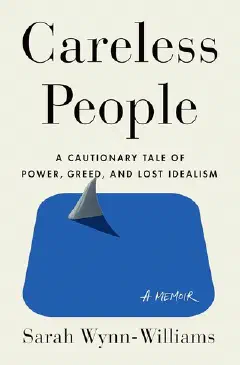
A Cautionary Tale of Power, Greed, and Lost Idealism
Sarah Wynn-Williams
—
2025
Sarah Wynn-Williams, former director of public policy at Meta, reveals the company's internal decision-making and Zuckerberg's leadership through documented accounts of Facebook's role in the Rohingya genocide, censorship pressures, and executive misconduct. Became a #1 NYT bestseller in March 2025 after Meta's legal attempt to suppress it.
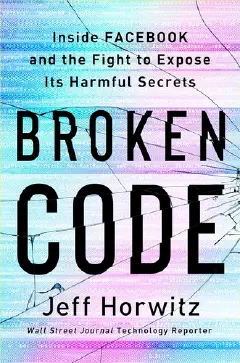
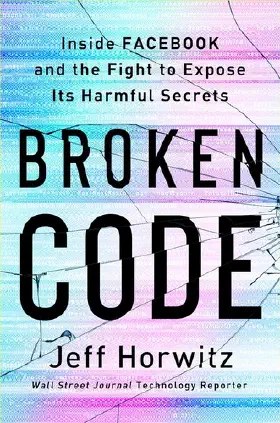
Inside Facebook and the Fight to Expose Its Harmful Secrets
Jeff Horwitz
—
2023
Jeff Horwitz, a Wall Street Journal reporter who won a Pulitzer Prize for his Facebook Files investigation, documents how company researchers proved the platform's harmful effects—and how leadership, including Zuckerberg, delayed, diluted, or suppressed these findings. A detailed account of institutional failure to address documented societal damage.
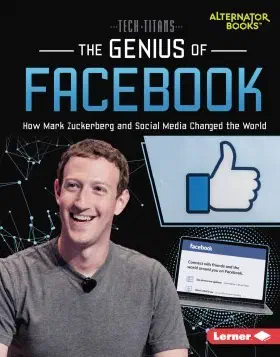
How Mark Zuckerberg and Social Media Changed the World
Dionna L. Mann
—
2022
Dionna L. Mann's biography for the Tech Titans (Alternator Books) series examines Mark Zuckerberg's innovations and their worldwide impact on social media, connection, and society. Part of a series profiling transformative technology leaders.
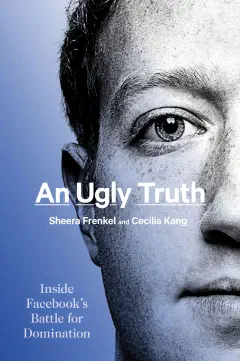
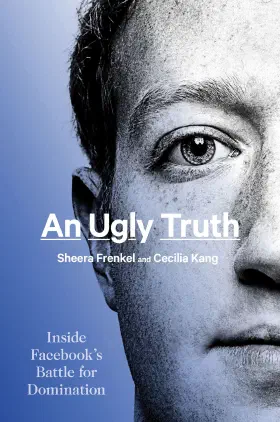
Pulitzer Prize finalist reporters Sheera Frenkel and Cecilia Kang investigate Facebook's ruthless pursuit of dominance. Using hundreds of interviews, they reveal how Zuckerberg's company navigated Russian interference, smear campaigns, and mass casualties while expanding globally—an examination of the company's political power and ethical compromises.
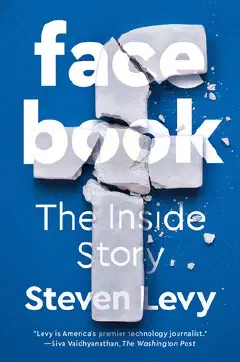
Renowned tech journalist Steven Levy's balanced examination of Facebook's rise and evolution, centered on Mark Zuckerberg's vision and decision-making. Argues the company's direction, culture, and choices reflect Zuckerberg's personal philosophy and ambitions.
Sarah Frier's meticulously researched narrative traces Instagram's founding by Kevin Systrom and Mike Krieger through their 2012 Facebook acquisition and the subsequent power struggles that ultimately led to both founders' departures. Won the 2020 Financial Times and McKinsey Business Book of the Year Award. Based on interviews with Instagram insiders, employees, competitors, and users.
Published by Rupa Publications, Abha Sharma explores the various avatars of Mark Zuckerberg—from elite hacker and Harvard dropout to the visionary CEO of Facebook, alongside his roles as philanthropist, son, friend, and family man. This 152-page biography weaves together Zuckerberg's professional achievements with his personal evolution, capturing the complexity of one of technology's most influential founders.
Roger McNamee, an early Facebook investor and mentor to Zuckerberg, recounts his awakening to the platform's destructive effects on democracy, mental health, and society. A scathing insider critique by someone who profited from but later opposed Facebook's trajectory. Named a Financial Times Best Business Book of 2019.
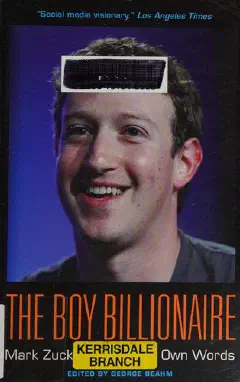
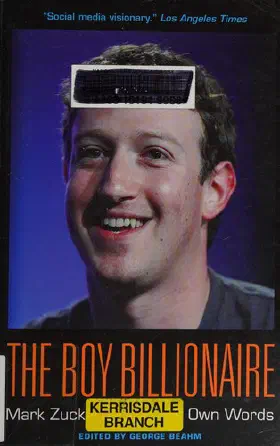
George Beahm (editor of I, Steve: Steve Jobs In His Own Words) compiles direct quotations from Zuckerberg organized by topic, presenting his personal philosophy, vision for technology, entrepreneurial insights, and views on social impact entirely through his own words rather than narrative biography.
Daniel Ichbiah's French-language biography tracing Mark Zuckerberg from his earliest years and formative years through his vision and leadership of Facebook's expansion into a global technology giant, his acquisition strategy, content moderation decisions, and recent pivot to artificial intelligence and the metaverse under Meta.
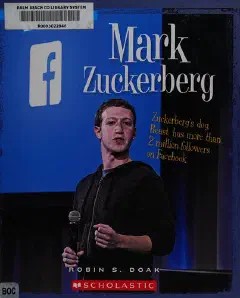
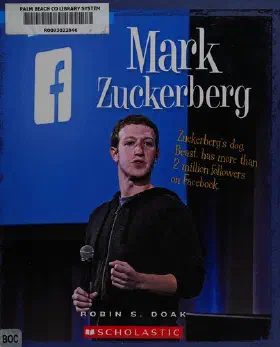
A biography aimed at young readers that covers Zuckerberg's creation of Facebook, the platform's rapid worldwide expansion, and his plans for the company's future. Part of the acclaimed True Book Biographies series published by Children's Press.
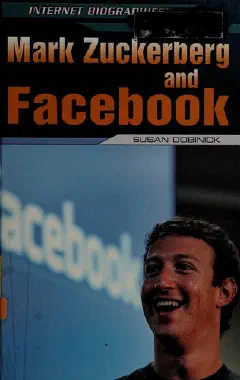
Susan Dobinick's biography traces Mark Zuckerberg's launch of TheFacebook in 2004 and the platform's transformation into a global communication phenomenon, exploring how the social network revolutionized business and worldwide connectivity.
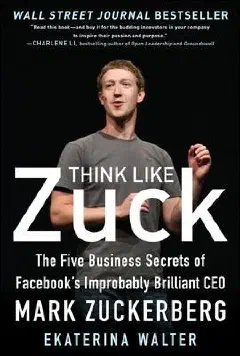
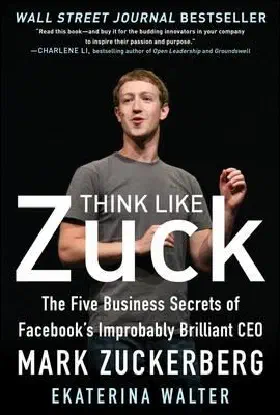
Think Like Zuck The Five Business Secrets Of Facebooks Improbably Brilliant Ceo Mark Zuckerberg
The Five Business Secrets of Facebook's Improbably Brilliant CEO Mark Zuckerberg
Ekaterina Walter
—
2013
Ekaterina Walter analyzes Mark Zuckerberg's leadership philosophy through five guiding principles, using Facebook's rise as the primary case study alongside examples from Apple, Zappos, and other innovators. Explores how visionary leaders like Zuckerberg pair with operators (e.g., Sheryl Sandberg) to drive transformation. A Wall Street Journal bestseller focused on entrepreneurial applications.
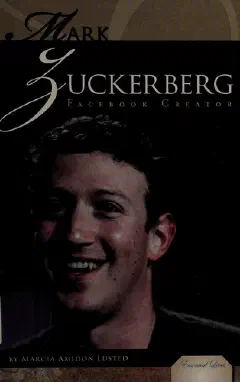
Marcia Amidon Lusted's biography for the Essential Lives series examines Mark Zuckerberg's background, education, and founding of Facebook. 112 pages of illustrated narrative with sidebars, timeline, and resources; aimed at student readers seeking his life story and impact.
A curated portrait composed entirely of direct quotations from Zuckerberg, compiled by George Beahm (editor of the bestselling I, Steve). The book reveals Zuckerberg's own perspective on founding Facebook, his business philosophy, and his vision for the company's impact, presenting his thinking without intermediary interpretation.
The Accidental Billionaires: The Founding of Facebook: A Tale of Sex, Money, Genius and Betrayal
Ben Mezrich
—
2010
The definitive behind-the-scenes narrative of Facebook's founding and Zuckerberg's rise. Mezrich chronicles the company's creation from a Harvard dorm room, the competitive battles with rivals like MySpace and Friendster, and the personal and legal conflicts—including the famous disputes with co-founders—that shaped Facebook's early years. Adapted into the acclaimed 2010 film The Social Network.
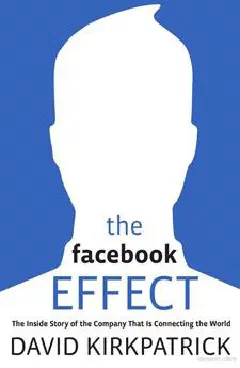
The Inside Story of the Company That Is Connecting the World
David Kirkpatrick
—
2010
Written with full cooperation of Facebook's executives, this narrative biography traces Zuckerberg's vision and leadership as Facebook grew from 500 million users to global dominance. Kirkpatrick examines Zuckerberg's strategic choices, refusal to sell the company, and the impact of his decisions on billions of users worldwide. Shortlisted for the 2010 Financial Times and Goldman Sachs Business Book of the Year Award.
Mark Zuckerberg is the most consequential non-researcher in modern AI, and he got there by making a bet nobody else at his scale was willing to make: give the weights away. When Meta released LLaMA in February 2023 — and the weights promptly leaked — it accidentally created the open-weights ecosystem that now underpins most of what independent developers can actually do with large language models. Zuckerberg turned the accident into a strategy. Llama 2 shipped with a commercial license in 2023, Llama 3.1 405B put a genuinely frontier-class model on Hugging Face in 2024, and an entire tooling layer — quantization, LoRA fine-tuning, local inference, llama.cpp, Ollama — grew up around models you could download. If you have ever run a serious model on your own hardware, you are living in the world Zuckerberg’s capital allocation decisions built.
He is not, and has never claimed to be, a researcher. He founded Facebook in a Harvard dorm in 2004, ran it through the mobile transition, the Cambridge Analytica scandal, and the 2021 rebrand to Meta, and spent roughly $50 billion trying to make the metaverse happen before pivoting hard. His actual contribution to AI is infrastructural and organizational: he funded FAIR under Yann LeCun starting in 2013, he let Meta open-source PyTorch — which won the research framework war outright — and he built the GPU fleet. The developer-friendly posture was never charity. Zuckerberg’s July 2024 letter argued open source is good for Meta precisely because Meta doesn’t sell model access; commoditizing the layer your competitors monetize is a classic strategic move, and he said so out loud.
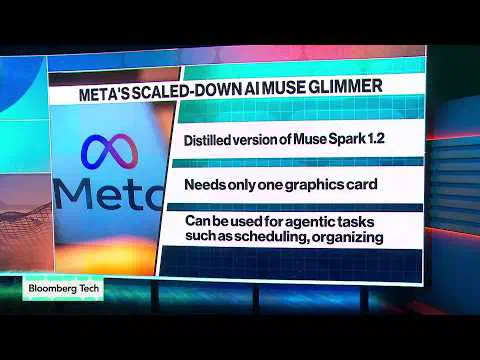
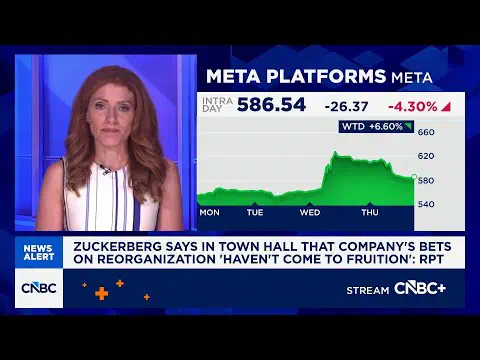
The 2025–2026 stretch is where the story gets uncomfortable. After Llama 4’s April 2025 launch drew accusations of benchmark gaming on LMArena, Zuckerberg blew up the org: $14.3 billion for a 49% stake in Scale AI, Alexandr Wang installed as Chief AI Officer, Meta Superintelligence Labs formed in June 2025, and compensation packages reportedly reaching $100–200 million to poach researchers from OpenAI and Google DeepMind. Six hundred people were laid off from the AI unit that October. Then on April 8, 2026, Meta split the road: Llama 5 shipped with open weights, and Muse Spark — Meta’s first closed-weight frontier attempt — shipped without them. Wang himself called Muse Spark “an appetizer” and conceded it isn’t at the tier of leading frontier models. The open-source evangelist now runs a dual-track strategy, and the community noticed.
For a developer today, Zuckerberg matters in two concrete ways. First, Llama 5 remains the most capable model family you can download, inspect, fine-tune, and run without an API key or a vendor relationship — that optionality is real and it exists because one person with control of a public company decided to fund it. Second, he is building the physical substrate: 2026 capex guidance of $125–145 billion, the 1 GW Prometheus cluster coming online in Ohio this year, and Hyperion in Louisiana scaling toward 5 GW. He’s floated selling excess capacity as a cloud business. Whether “personal superintelligence” — an AI agent for every individual, delivered through smart glasses rather than a chat box — is a genuine thesis or a differentiated pitch against Sam Altman’s more centralized framing is the open question. Judge it by whether the next Llama still has downloadable weights.
Training data and copyright. Meta faces sustained litigation over how Llama’s training corpus was assembled. The Kadrey v. Meta suit brought by Sarah Silverman and other authors was dismissed in 2025 on the specific record presented, but in May 2026 five major publishers — Elsevier, Cengage, Hachette, Macmillan, McGraw Hill — filed a class action alleging Meta trained on 267+ TB of pirated material, masked IP addresses to avoid detection while torrenting, and abandoned licensing talks at Zuckerberg’s direction. A further textbook-author suit followed in July 2026. Meta disputes the characterizations; the cases are unresolved.
Teen safety and AI companions. Unsealed filings allege Zuckerberg overruled internal safety staff to push a “choice and non-censorship” philosophy for AI chatbot companions, permitting “racier” interactions, in a case concerning sexualized content reaching minors on Facebook and Instagram. Meta says the documents paint a “flawed and inaccurate picture.”
What “open source” means. The Open Source Initiative has repeatedly stated that Llama’s license — with its 700M-MAU restriction and use limitations — is not open source, and that Meta’s marketing muddies a term with a specific meaning. Training data has never been released for any Llama model. The critique is narrow but correct: “open weights” is the accurate phrase.
Llama 4 benchmarking. Independent researchers found Meta had submitted a specially tuned variant to LMArena that differed from the public release. Meta acknowledged the experimental variant; the episode cost real credibility with the developer community and preceded the 2025 reorg.
Capex risk. The $125–145 billion 2026 spend rattled investors and depends on returns that remain speculative. Zuckerberg has said he’d rather overbuild than underbuild — a defensible position that is also, for now, unfalsifiable.
Spotify Podcasts
Mark Zuckerberg on Muse, New Audio-Only Glasses and Killer AI
New Things with Joanna Stern
2026
Mark Zuckerberg
Colossus Magazine
2026
Mark Zuckerberg on Muse, Meta's biggest AI bet yet
Sources with Alex Heath
2026
Mark Zuckerberg has an Instagzam
The Vergecast
2026
Mark Zuckerberg on AI's Job Impact, Government Regulation, & How Meta Glasses Changed His Routine
Complex
2026
An Interview with Meta CEO Mark Zuckerberg About AI and the Evolution of Social Media
Stratechery
2025
#579 - Mark Zuckerberg
This Past Weekend w/ Theo Von
2025
#2255 - Mark Zuckerberg
The Joe Rogan Experience
2025
Mark Zuckerberg — Llama 3, $10B models, Caesar Augustus, & 1 GW datacenters