Principal Scientist at Google DeepMind, author of Probabilistic ML books
Kevin Murphy
Profile
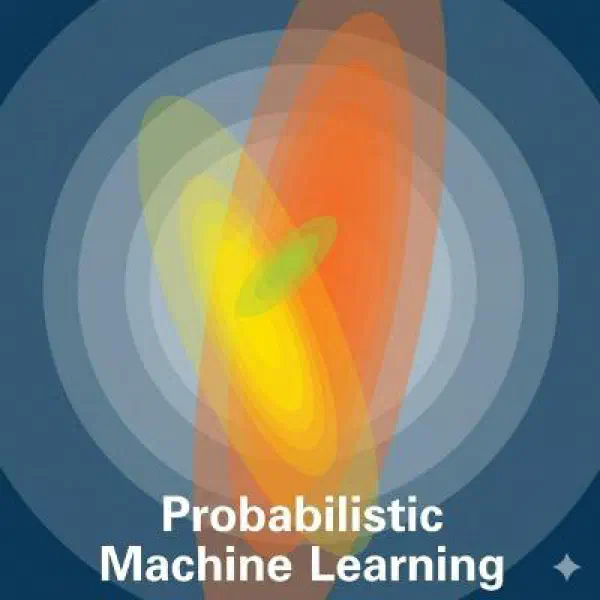
If you’ve spent any serious time learning machine learning the rigorous way, you already own a Kevin Murphy book — or you’ve photocopied someone else’s. Kevin Patrick Murphy is a Principal Scientist at Google DeepMind and the author of what is arguably the most complete single-author reference in the field: a 2012 doorstop, Machine Learning: A Probabilistic Perspective, followed a decade later by a two-volume rewrite. Born in Ireland, raised in England (BA, Cambridge), trained in the US (MEng at Penn, PhD at UC Berkeley under Stuart Russell, postdoc at MIT), he spent 2004–2011 as a professor at the University of British Columbia before a 2011 Google sabbatical turned permanent. He’s been at Google — first Brain, now DeepMind — ever since.
What sets Murphy apart from the celebrity-researcher tier of AI is that his lasting influence is pedagogical. His books treat machine learning as applied probability first and engineering second: everything is a distribution, inference is the unifying verb, and deep learning is one chapter in a much longer story that also includes graphical models, Bayesian inference, causality, and state-space models. For a developer who wants to understand why a transformer or a diffusion model works rather than just calling .fit(), this framing is gold. It’s also demanding — these are graduate-level texts, not weekend tutorials — but Murphy has kept the full drafts free online for years, which is why nearly every ML PhD student of the last decade has read him.
His research career predates the deep learning boom and grounds it. His 2002 Berkeley thesis on Dynamic Bayesian Networks (a unifying view of HMMs, Kalman filters, and their generalizations) remains heavily cited, and his work on graphical models, approximate inference, and probabilistic programming shaped how a generation thinks about structured uncertainty. At Google he’s ranged widely: knowledge-graph embeddings, trajectory prediction, reliability and uncertainty (the Plex line of work), multimodal generation with frozen LLMs (SPAE), and lately diffusion models for control and video.
Today he manages a team of roughly 28 researchers and engineers at DeepMind working across generative models (diffusion and LLMs), reinforcement learning, robotics, and Bayesian inference. He’s also a prolific open-source maintainer — the JAX-based dynamax library for state-space models grew directly out of the second book. If your mental model of AI is “scale is all you need,” Murphy is a useful corrective: he’s the person insisting the probabilistic foundations still matter, and he’s written the reference that proves it.
Books
Key Articles & Papers
Dynamic Bayesian Networks: Representation, Inference and Learning A Review of Relational Machine Learning for Knowledge Graphs SPAE: Semantic Pyramid AutoEncoder for Multimodal Generation with Frozen LLMs Plex: Towards Reliability using Pretrained Large Model Extensions Dynamax: A Python package for probabilistic state space modeling with JAX Diffusion Model Predictive ControlVideos

YouTube