

Runway CEO, generative video and world models
Cristóbal Valenzuela
Profile
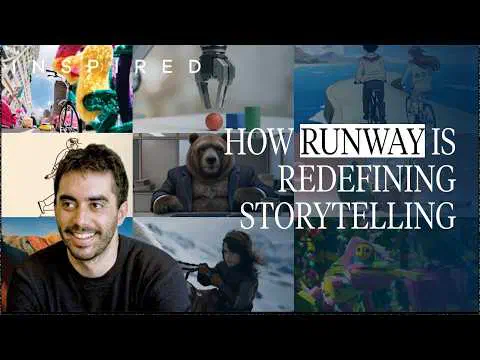
Cristóbal Valenzuela is the co-founder and CEO of Runway, the company that did more than almost anyone to drag generative video out of the research lab and into the hands of working filmmakers. Born in Santiago, Chile, in 1989, Valenzuela came to AI sideways — not through a PhD in a machine-learning group, but through economics and business studies at Universidad Adolfo Ibáñez, followed by NYU’s Interactive Telecommunications Program at Tisch. He’s the rare frontier-AI CEO who calls himself an artist first, and it shows in how Runway frames its work: not “we are building a model,” but “we are building a new medium.” For developers, he’s a useful counterexample to the assumption that serious AI only comes out of the big labs.
Runway’s technical footprint is larger than its size suggests. Founded in December 2018 with Anastasis Germanidis and Alejandro Matamala, the company was a genuine co-author of the diffusion moment — Runway researchers were part of the team behind latent diffusion and the original Stable Diffusion release, and Runway shipped the widely-used Stable Diffusion 1.5 weights. It then went its own way on video, releasing Gen-1 and Gen-2, the breakout Gen-3 Alpha, and the Gen-4 / Gen-4.5 line that has traded the top of independent video leaderboards with OpenAI’s Sora and Google’s Veo. This is a company punching well above its headcount against labs with vastly more compute.
Where Valenzuela gets genuinely interesting — and where developers should pay attention — is his insistence that AI video was only ever “the prequel.” Runway’s real bet is on world models: systems that don’t just render plausible frames but simulate the physics and persistence of an environment. The company shipped GWM-1 in December 2025 with three variants (Worlds, Avatars, and Robotics), explicitly reaching past entertainment toward robotics, simulation, and synthetic training data — territory usually staked out by the frontier labs. A February 2026 Series E raised $315M at a $5.3B valuation to pre-train the next generation of these models, and a GTC 2026 collaboration with NVIDIA demonstrated real-time HD generation with time-to-first-frame under 100 milliseconds.
The strategic tell is Runway’s relationship with Hollywood. Rather than treating studios as adversaries, Valenzuela cut the first-of-its-kind training deal with Lionsgate in 2024 — later expanded into an equity partnership — signaling a “work with the incumbents” posture that stands in sharp contrast to the scrape-first, apologize-later approach of much of the industry. He’s a TIME 100 AI honoree and a prolific essayist, and his blog is worth reading if you want to understand how someone from an arts background thinks about the coming decade of generative media.
Key Articles & Papers
Universal World Simulator A New Medium Creative Software 2.0 We're Solving Graphics Backwards World Building The Cost of a Frame
Videos

Controversies
Like every generative-video company, Runway sits at the center of the training-data fight. In July 2024, reporting (originally by 404 Media) alleged that Runway trained models on scraped YouTube videos without permission, part of a broader industry pattern that many creators view as uncompensated appropriation of their work. Valenzuela and Runway have largely declined to detail their training corpus, which fuels the criticism.
More broadly, Valenzuela is a lightning rod in the debate over AI’s impact on creative labor. The Lionsgate deal — and Runway’s positioning as a tool for studios — draws praise from some in the industry as a licensed, artist-respecting path forward, and sharp criticism from others who see any studio–AI partnership as a step toward displacing writers, VFX artists, and crews. Valenzuela’s public line is that these tools augment rather than replace creators; whether that holds is one of the open questions developers building in this space will have to reckon with honestly.
Spotify Podcasts








YouTube